 +44(0)1865 891466
What Information Does a Filling Machine Supplier Need Before Quoting?

A complete guide on how to write a bottling URS (User Requirements Specification)
A filling machine quote is only as accurate as the information behind it. Suppliers who quote from incomplete specifications tend to produce numbers that shift once trials begin, and those shifts usually move in one direction: upward.
Getting the specification right at the enquiry stage is the single most effective way to avoid delays, re-quotes, and equipment that underperforms once installed.
This isn’t a matter of filling in a form. It’s a matter of understanding what a supplier actually does with each piece of information, and why gaps in any one area can undermine the accuracy of the whole quote.
Product characteristics
The product to be filled determines almost every downstream decision on machine type, so this comes first when you write a bottling URS.
Viscosity
A range in centipoise (cP), not a qualitative description. “Thin” and “thick” mean different things to different people; a number lets the supplier match pump or nozzle technology correctly. Viscosity that varies with temperature or shear also needs stating, since some products behave very differently at 5°C versus 25°C, or after agitation.
Flow behaviour
Newtonian or non-Newtonian, foaming or non-foaming, and whether the product contains particulates, fibres, or suspended solids. Foaming products generally require bottom-up or no-drip filling to control head space accurately. Particulates rule out certain pump types entirely.
Shear sensitivity
Relevant for emulsions, suspensions, and some biologics, where aggressive pumping action can damage the product or cause phase separation.
Corrosiveness and temperature
Whether the product is filled hot, cold, or at ambient, and whether it is corrosive to standard contact materials. This affects the specification of seals, gaskets, and wetted parts, and may require full 316L stainless contact parts or PTFE seals rather than standard alternatives.
Product environment
Does the product need to be hygienic or food safe? Is it flammable, needing an ATEX environment? Is it sensitive to static?
Container specification
Format range
The full range of container sizes and types the line needs to accommodate, not just the most common one. A supplier quoting for a single 500ml bottle will size the machine differently than one quoting for a range running from 30ml to 1 litre. If changeover between formats is needed, say how often and how quickly it must happen when writing a bottling URS, since this drives the choice between manual, semi-automatic, and tool-less automatic changeover systems.
Container material and rigidity`
Glass, HDPE, PET, or collapsible tubes each demand different handling and nozzle approach. Rigid containers can be filled at higher line pressure than semi-rigid ones, which may deform under an aggressive filling stroke.
Neck finish and closure type
Relevant if capping is to be integrated into the same line, since neck finish dictates cap-chuck design and torque settings. The neck diameter is also important so we can size the dispenser nozzle size, which in turn will have an effect on the filling rate.
Fill volume and accuracy requirements
Target fill volume and acceptable tolerance
Stated as a percentage or an absolute value (for example, ±0.5% or ±0.1ml), not as a general instruction to “fill accurately.” Regulated products, particularly pharmaceutical and nutraceutical formulations subject to weights and measures legislation, often have defined tolerance limits that the filling technology must be capable of holding consistently, not just on a good day. Other sectors – Health and Beauty for instance – fill to a visual level like the start of the neck line.
Fill method preference, if any
Volumetric (gear pump, peristaltic, piston) or net weight filling. Net weight filling is generally required where the regulatory framework specifies fill by weight rather than volume, or where product density varies between batches.
Throughput and line integration
Required output rate
Expressed in units per minute or per hour, and whether this reflects current demand, projected demand, or both. A machine sized for today’s volumes with no allowance for growth is a common source of a second, unplanned capital purchase within two years. You can use our calculator to judge whether you need semi or fully automatic machines here.
Upstream and downstream equipment
Whether the filler needs to integrate with an existing conveyor, capper, labeller, or checkweigher, and the make and interface type of that equipment. Integration constraints, such as fixed conveyor height or an existing PLC architecture, need to be flagged early rather than discovered during installation. If you have tight torque specifications, then the right capper is essential when writing a bottling URS.
Operating pattern
Single shift, multiple shifts, or continuous operation, since this affects duty cycle expectations and maintenance scheduling built into the design.
Regulatory and environmental requirements
Applicable standards
UK GMP as set out in MHRA’s Orange Guide, ISO 22716 for cosmetics, or other sector-specific requirements. Where electronic records and audit trails are involved, the relevant reference point in the UK is EU GMP Annex 11, which MHRA has adopted as the standard for computerised systems in GxP environments. These requirements affect material selection, documentation requirements (IQ/OQ/PQ, material certificates), and whether features like electronic batch records or audit trails need to be built in from the outset. Read our white paper on GMP Compliance here.
Cleanroom classification
If applicable, since this constrains machine construction, ingress protection rating, and whether the equipment needs to be designed for CIP (clean-in-place) or SIP (sterilise-in-place) operation rather than manual breakdown and cleaning. Read our article on sterilisation and anti-counterfeiting here.
Hazardous product handling
Whether the product is flammable and requires equipment rated under the UK’s DSEAR and UKEX framework (the UK’s post-Brexit equivalent of the EU’s ATEX regime), or needs containment for operator protection (relevant for certain active pharmaceutical ingredients).
Site and utility constraints
Available floor space
Including height restrictions, and whether the machine needs to fit into an existing line footprint or a new build.
Utilities available
Compressed air pressure and volume, electrical supply (voltage, phase), and any restrictions on noise or emissions specific to the site.
Changeover and cleaning philosophy
Whether format changes and cleaning cycles need to be fast enough to fit within a defined changeover window, which affects decisions on tool-less parts, quick-release fittings, and CIP integration.
Commercial and timeline factors
Budget range
Even an approximate one. This lets a supplier propose realistic options rather than a specification that is technically ideal but commercially unworkable, or conversely, a machine that undershoots what the budget could actually deliver.
Installation timeline
Including any hard deadlines tied to regulatory submissions, product launches, or contractual commitments to customers.
Validation requirements and expected documentation package
Since these affect lead time as much as the physical build.
Commercial and timeline factors
Every specification you write in a bottling URS maps directly to a design decision: pump type, contact material, changeover mechanism, control architecture, or documentation package. A supplier working from partial information has to make assumptions to fill the gaps, and assumptions made at the quoting stage tend to become expensive corrections at the commissioning stage. Products that turn out to be more viscous than described, container formats added after the fact, or a regulatory requirement mentioned only after the machine has been built are the most common causes of project delay in filling line procurement.
The more precisely you can answer the questions above when you write a bottling URS before requesting a quote, the more accurately that quote will reflect the machine that actually gets delivered.
Read our accompanying article on strategic planning for bottling and capping lines here.
Built for Modern Manufacturing
Today’s manufacturing environment is changing fast. Labour shortages. Skills gaps. Increasing product complexity. In this landscape, relying on highly specialised operators isn’t scalable.
You need systems that are:
- Easy to learn
- Easy to operate
- Easy to trust
That’s exactly what Cap Coder delivers.
Automation shouldn’t slow you down. It should move your business forward.
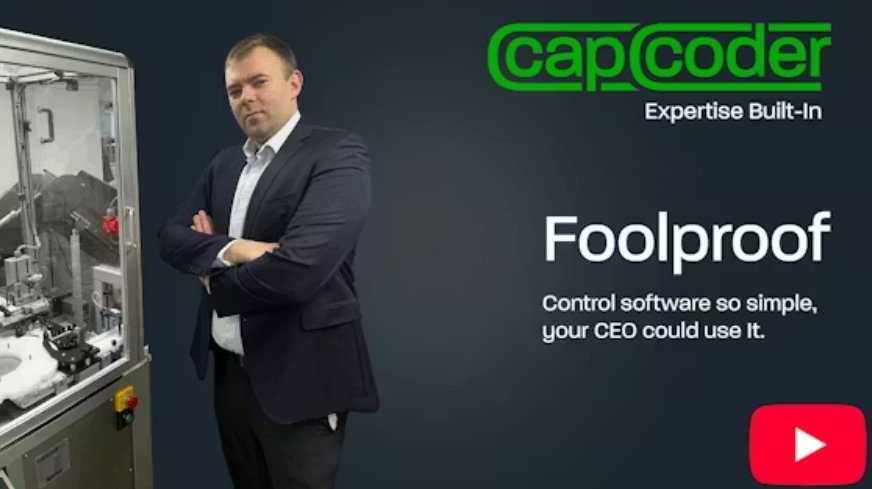
With foolproof control software and Expertise Built-In, Cap Coder machines simplify operation, reduce errors, and give you complete confidence on the production line.
Prefer to see it in action?
Watch how our intuitive control software performs on a real production line, and hear directly from customers who’ve reduced training time, cut errors, and taken back control of their processes.
Ready to Boost your Productivity?
Get in touch today and one of our friendly sales engineers will be in contact shortly.