 +44(0)1865 891466
Sterilisation Traceability & Anti-Counterfeiting in Bottling and Capping Lines

For manufacturers in the pharmaceutical, healthcare, and beauty sectors, sterilisation and traceability are both critical, but too often managed as separate disciplines.
As regulatory expectations increase and supply chains become more complex, this separation introduces risk. A fully effective strategy requires these systems to be designed and implemented as part of a single, integrated line architecture.
This is where specialist engineering partners play a key role, ensuring that bottling and capping lines are not only operationally efficient, but also fully aligned with modern traceability and anti-counterfeiting requirements from the outset.
The Growing Importance of End-to-End Traceability
Traceability has evolved significantly in recent years. Traditional batch-level tracking is no longer sufficient for many applications, particularly in regulated environments.
Today’s expectations include:
- Unit-level serialisation
- Full data capture across the production lifecycle
- Rapid, targeted recall capability
- Audit-ready data integrity
For senior managers commissioning new lines, this means traceability must be considered as a core design requirement, not an add-on.
A well-designed system links:
- Filling and capping operations
- Sterilisation processes
- Inspection systems
- Packaging and labelling
All within a unified data structure.
Sterilisation Data: From Process Control to Product Evidence
A Sterilisation is fundamental to product safety. However, its value extends beyond process validation.
When properly integrated into a traceability system, sterilisation data becomes:
- Verifiable evidence tied to individual product units
- A tool for root cause analysis
- A key component of regulatory compliance
Without this integration, sterilisation records remain isolated, making it difficult to associate specific process conditions with products in the market.
At Capcoder, our approach to line design ensures that sterilisation systems are not standalone, but connected to the broader control and data environment of the bottling line.
Anti-Counterfeiting: Beyond Basic Serialisation
Counterfeiting remains a significant concern across pharmaceutical and personal care markets.
While serialisation is an essential foundation, it’s not sufficient on its own. Effective anti-counterfeiting strategies require:
- Secure code generation and management
- Verification systems across the supply chain
- Tamper-evident packaging integration
- Data consistency between physical products and digital records
The challenge for manufacturers is ensuring that these elements are fully embedded within the production line, rather than implemented as disconnected systems.
This is particularly relevant during commissioning, where early design decisions determine long-term system effectiveness.
The Role of Line Integration in Risk Reduction
A common issue in new installations is the fragmentation of responsibilities:
- Equipment suppliers focus on individual machines
- Serialisation vendors focus on coding and software
- IT teams focus on data systems
Without a unifying integration strategy, gaps can emerge between these areas.
At Capcoder, we specialise in bridging these gaps by delivering fully integrated bottling and capping lines, where:
- Equipment is selected and configured as part of a cohesive system
- Control architectures support both operational efficiency and data integrity
- Traceability and serialization are embedded at every stage
This approach reduces the risk of:
- Data inconsistencies
- Integration delays
- Compliance challenges during validation and audit
Designing for Compliance and Future Scalability
Regulatory frameworks continue to evolve, particularly in relation to:
- Data integrity (e.g. ALCOA+ principles)
- Track-and-trace requirements
- Supply chain transparency
As a result, manufacturers need systems that are not only compliant today, but adaptable for future requirements.
Key considerations during line commissioning include:
- Scalable serialisation architecture
- Integration with MES and ERP systems
- Flexible data capture and reporting capabilities
- Validation-ready system design
By addressing these at the design stage, manufacturers avoid costly retrofits and operational disruption later.
Practical Considerations for Senior Decision-Makers
When commissioning a new bottling or capping line, it’s important to assess:
1. Integration Strategy
Is there a single point of responsibility for system integration?
2. Data Architecture
How are sterilisation, production, and serialisation data linked?
3. Compliance Readiness
Does the system support validation, audit trails, and regulatory reporting?
4. Supplier Coordination
Are all equipment and software providers aligned within a unified design?
5. Long-Term Support
Will the system remain adaptable as requirements evolve?
Capcoder’s project-led approach is designed to address these questions early, ensuring that traceability and anti-counterfeiting capabilities are built into the system, not retrofitted later.
Conclusion
Sterilisation traceability and anti-counterfeiting are now central to the design of modern bottling and capping lines.
Achieving effective implementation requires:
- Integrated system design
- Robust data management
- Close coordination between equipment, software, and process engineering
By working with experienced integration partners such as Capcoder, manufacturers can ensure that these elements are addressed holistically, supporting compliance, protecting product integrity, and enabling long-term operational reliability.
We’ve written a useful guide on how to write a bottling URS to help you integrate your compliance requirements into your specification. Read it here.
Built for Modern Manufacturing
Today’s manufacturing environment is changing fast. Labour shortages. Skills gaps. Increasing product complexity. In this landscape, relying on highly specialised operators isn’t scalable.
You need systems that are:
- Easy to learn
- Easy to operate
- Easy to trust
That’s exactly what Cap Coder delivers.
Automation shouldn’t slow you down. It should move your business forward.
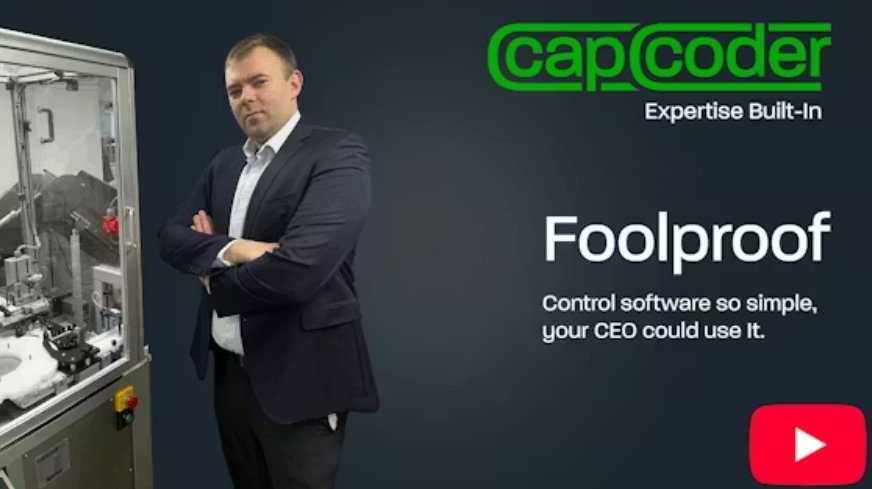
With foolproof control software and Expertise Built-In, Cap Coder machines simplify operation, reduce errors, and give you complete confidence on the production line.
Prefer to see it in action?
Watch how our intuitive control software performs on a real production line, and hear directly from customers who’ve reduced training time, cut errors, and taken back control of their processes.
Ready to Boost your Productivity?
Get in touch today and one of our friendly sales engineers will be in contact shortly.