 +44(0)1865 891466
MK VI Torque Head
What makes Cap Coder so special? Its our world famous capping head. This industry leading design allows perfect torque control.
With its unique ability control torque and speed of capping via intelligent feedback. Plus its unique two or three jaw grippers. Our torque head is the real star.
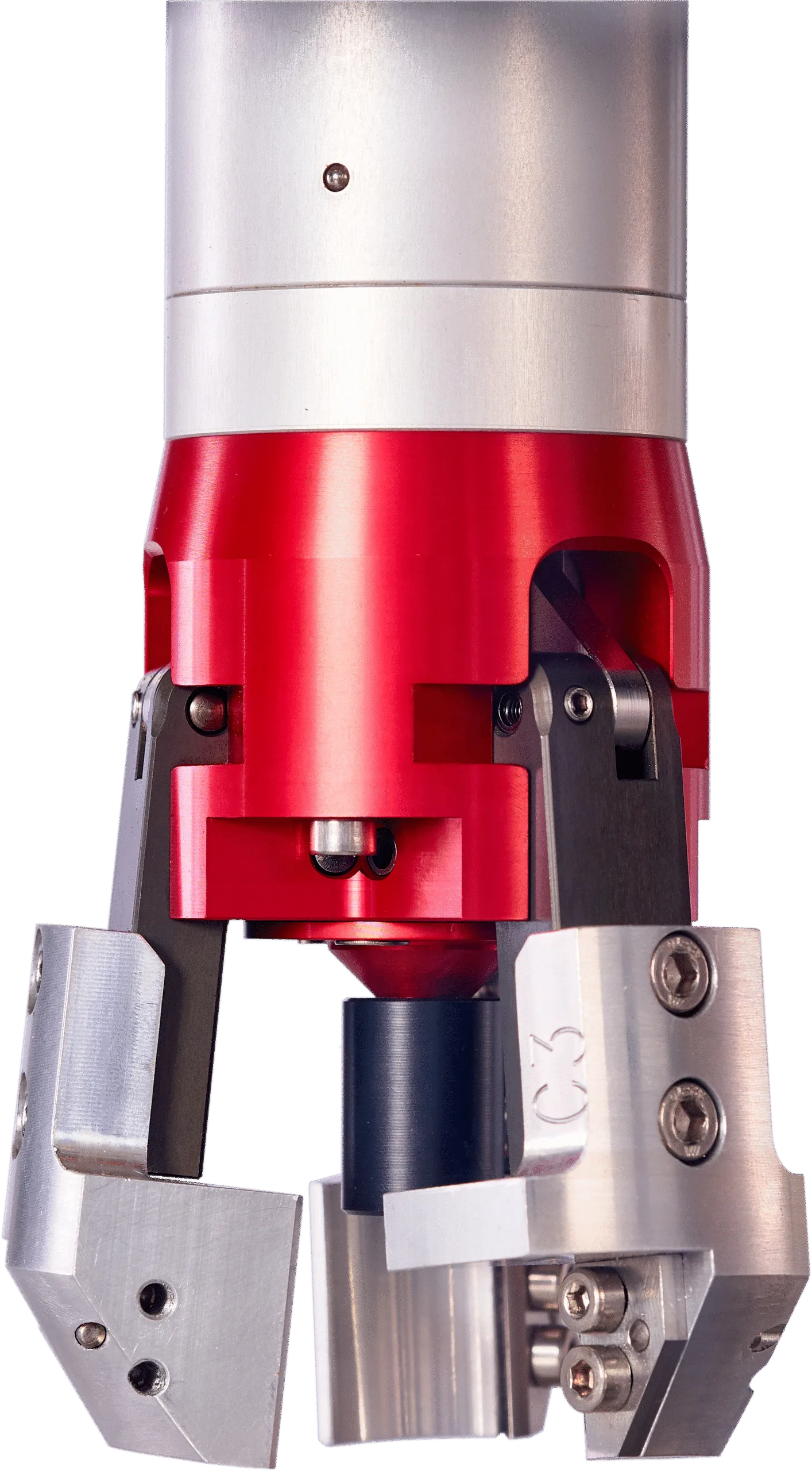
The MK VI Torque Head
Our capping head is the perfect choice for not just our own machines, but also can be found on many other branded machines across the world. Nothing beats our capping head in terms of performance and accuracy.
It doesn’t matter what your cap application is we have variants that will be able to ensure accurate and reliable cap closure on your products.
The Cap Coder Torque Head, comes as standard with torque and speed control, which uses intelligent feedback to control to application of your cap or even a trigger spray…
What about odd shaped caps and trigger sprays? Unlike many other products on the market, our capping head can work with almost any cap. Trigger sprays we take in our stride, we can even orientate trigger sprays to degree precision.
An optional extra available is a torque transducer, enabling calibrated measuring. Torque transducer models can not only can measure the applied toque but can also measure undoing torque, with all readings and batch data logged and available to download from the system.
How Does The Capping Head Work?
A Basic Understanding.
Our MK VI capping head, has three main functions, to grip the cap, rotate the torque head and apply downwards pressure onto the cap. This is controlled through a combination of pneumatic and electrical components.
The cap grip is controlled through a regulator on the machine, and activated through a solenoid valve which in turn is controlled through the PLC program. With a separate pressure regulator the operator can adjust the grip to suit the cap being applied.
The rotational motion of the capping machine is provided through a custom DC motor which combined with a motor controller allows control over speed and torque. Allowing integration within the machine controls and give the user the ability to set different speeds and torque applications for different products in recipes.
Once more connected with a torque transducer we can also measure the torque applied and give feed back in many different forms.
Downwards force can be provided through either a pneumatic cylinder or a linear servo driven assembly. Either option will apply downwards for in a controlled manor, but the linear servo driven assembly also allows the ability to set different product heights in recipes, allowing easier control and setup of a machine.

Torque Transducers
Using Cap Coders proven CC720 Mk6 Servo driven capping head integrated with Sensor Technology’s high precision RWT torque transducer, has led to a very sophisticated and flexible torque testing unit that can be programmed in a number of ways.
Cap Coders Torque Testing unit was developed in accordance with new Pharmaceutical legislation that requires validation of certain products and to ensure and prove that no un-qualified products can process further through the manufacturing cycle.
In machines with a reject station, any product outside of the customers set torque tolerances are automatically rejected. On more manual machines an alarm is activated and/or a warning on the HMI indicating the failure and the machine will not operate again until the rejected product is removed.
Being able to integrate the units into any one of our range of capping machines means that we have integrated this system into the CC1440 bench top machine in laboratories running small batch testing up to CC1160 Monobloc’s running in a fully automatic production environment.
The Torque testing unit can be programmed in a number of ways, i.e. it might be desirable for the unit to test the release torque of one cap in every 10, 20 or 50 containers. In this scenario, the torque head will apply the cap, read and record the torque, then un-do the cap, again reading and recording the opening torque before it then re-applies the cap once more for it to continue onto the next cycle.
Key Features
Calibration

All Torque Transducers are calibrated to UKAS standards by the original manufacturer.

Torque Transducers, How Do They Work?

A Basic Understanding.
These transducers operate using a four-element strain gauge wheatstone bridge, which is connected to a miniature shaft mounted analog to digital converter and microcontroller. The microcontroller conditions and measures the strain gauge bridge output as close to the gauges as possible, eliminating any possible external noise pick up in the gauge wiring.
The shaft mounted electronic module is wirelessly powered by a radio frequency source which drives a stator coil, the output of which is received by a rotor coil on the shaft thus making the system completely contactless. This eliminates the need for slip rings and their associated wear and noise problems.
The shaft microcontroller outputs a digital serial stream that is transferred back from rotor to stator by modulating the impedance of the rotor coil and detecting the impedance changes at the stator coil. A secondary high-performance microcontroller receives the serial stream from the shaft microcontroller, which then performs calibration and temperature compensation before outputting the results digitally via RS232, CAN bus or USB. A 16-bit digital to analog converter also outputs the sensors data as a fully calibrated and compensated analog voltage or current.
Ready to Boost your Productivity?
Get in touch today and one of our friendly sales engineers will be in contact shortly.