 +44(0)1865 891466
Strategic Planning for an Automated Bottling & Capping Line

What Every Operations Leader Must Get Right (Before the First Bolt Is Tightened)
Let’s start with an uncomfortable truth: most bottling line problems don’t start on the factory floor, they start in the planning room.
When executives decide to upgrade or invest in a new automated bottling and capping line, the conversation often begins with equipment specifications and throughput targets. But the real success of the project is determined long before machines arrive on site.
A modern automated line is a complex ecosystem of filling, capping, inspection, robotics, and data systems working in perfect synchronisation. Get the strategy right and the line becomes a competitive advantage. Get it wrong and you’ve built a very expensive traffic jam.
Here are the critical points you should address if you’re planning an upgraded or new automated bottling and capping line.
Start With the End in Mind: Throughput and Future Capacity
Executives understandably focus on current production demand. But smart facilities plan for where production will be in 3–7 years, not just next quarter.
Fully automated bottling systems can process anywhere from tens to thousands of containers per minute depending on configuration.
Key questions to ask early:
- What are the projected production volumes over the next 5 years?
- How many SKUs will the line need to handle?
- Will market growth require additional capacity or parallel lines?
Designing a line that only solves today’s problem often guarantees tomorrow’s capital request. Your finance team will love that. Your shareholders probably won’t.
Design the Line as a System, Not a Collection of Machines
A bottling line is only as fast as its slowest machine.
Filling machines, cappers, labellers, conveyors and inspection systems must operate as a synchronised production system. If one machine runs faster or slower than the others, you’ll create bottlenecks, downtime, or product loss.
Strategic considerations include:
- Matching throughput between filling, capping and labelling modules
- Line balancing and buffer zones
- Accumulation tables to smooth product flow
- End-of-line robotics and palletising
Think of the line like a Formula 1 pit crew. If one person drops a wheel nut, the race is over.
Product and Packaging Complexity
Not all bottles behave themselves.
Pharmaceutical and cosmetic packaging comes in every imaginable shape, material and closure type. Glass vials, PET bottles, pumps, droppers, flip tops, sprays; each requires different handling and torque parameters.
For example:
- Irregular or fragile containers may need specialised guides and sensors to prevent tipping or scratching.
- Different closures demand adjustable torque control and flexible capping heads.
Translation: design for your packaging reality, not the theoretical bottle that appears in equipment brochures.
Reduce Errors, Increase Control
Operator error is one of the biggest risks in any production environment. And more often than not, it’s caused by unclear or overly complex systems.
Our approach is simple: remove the opportunity for error wherever possible.
Compliance, Hygiene and Validation
In pharmaceutical and health & beauty production, automation has to support regulatory compliance as much as productivity.
Modern lines incorporate:
- GMP-compliant materials and sanitary design
- Clean-in-Place (CIP) systems for automated cleaning
- Vision inspection systems to verify caps, fill levels, and coding
- Traceability and batch identification systems
In highly regulated sectors, quality assurance isn’t optional, it’s designed directly into the line.
If your system can’t demonstrate process integrity, auditors will happily demonstrate it for you.
Flexibility for SKU Proliferation
The modern pharmaceutical and beauty markets love variety.
More products. More sizes. More formulations. More packaging types.
That means your line must support:
- Rapid changeovers
- Tool-less adjustments
- Recipe-driven control systems
- Multiple bottle sizes and formats
Modern automated systems can be configured to handle different containers and fill volumes with minimal mechanical changes, giving manufacturers the agility needed for diverse product ranges.
In short: the line should adapt to the business, not the other way around.
Automation, Data and Control Systems
Today’s bottling lines are as much software as they are stainless steel.
Integrated PLC and HMI systems coordinate speeds, recipes and fault handling across all equipment modules. The HMI interface should be clear and simple to use to avoid user error, particularly when expensive specialist engineering expertise is in short supply. Simple-to-use HMIs allow you to deploy more generalist operators.
Strategic planning should include:
- Centralised control architecture
- Digital production data and performance monitoring
- Integration with MES or ERP systems
- Predictive maintenance capabilities
Because if the only way to diagnose a production problem is “listening carefully to the machine,” you’re leaving valuable operational intelligence on the table.
Inspection and Quality Assurance Built Into the Line
AHigh-speed production can’t come at the expense of product quality.
Automated bottling systems increasingly include inline inspection technologies such as:
- Vision systems for cap placement and label verification
- Fill level checks
- Weight verification
- Contamination detection
These systems help prevent defective products from progressing downstream, protecting both brand reputation and regulatory compliance.
Because the only thing worse than producing a faulty batch…
…is shipping it.
ROI: The Strategic Case for Automation
Automation requires capital investment, so you need to make sure the return is compelling.
Automated bottling lines increase throughput, reduce labour requirements, improve hygiene, and minimise human error.
For most facilities, the benefits include:
- Higher production capacity
- Reduced operating costs
- Greater consistency
- Faster time-to-market
These are points your MD and FD will want to hear. In competitive pharmaceutical and beauty markets, that operational advantage can quickly become a strategic one.
Final Thought: Automation Is a Strategy, Not Just Equipment
An automated bottling and capping line isn’t simply a collection of machines, it’s a critical part of your manufacturing strategy.
The most successful projects begin with clear operational goals, thoughtful system design, and partners who understand both the engineering and the industry.
Because when automation is done right, production flows smoothly, quality remains uncompromised, and the only thing moving faster than your bottles…
…is your business.
Finally, when you’ve completed your strategy, we’ve written a guide on how to write a bottling URS (User Requirements Specification), the next step in your line planning. Read it here.
Built for Modern Manufacturing
Today’s manufacturing environment is changing fast. Labour shortages. Skills gaps. Increasing product complexity. In this landscape, relying on highly specialised operators isn’t scalable.
You need systems that are:
- Easy to learn
- Easy to operate
- Easy to trust
That’s exactly what Cap Coder delivers.
Automation shouldn’t slow you down. It should move your business forward.
With foolproof control software and Expertise Built-In, Cap Coder machines simplify operation, reduce errors, and give you complete confidence on the production line.
Prefer to see it in action?
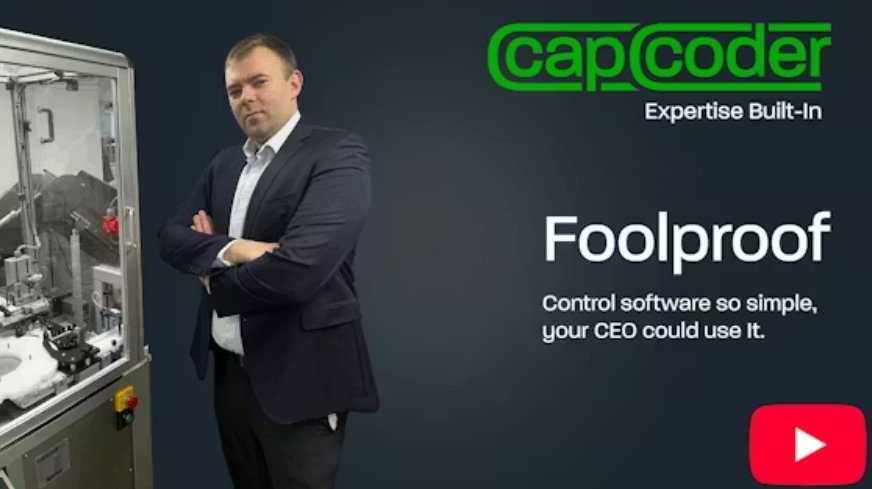
Watch how our intuitive control software performs on a real production line, and hear directly from customers who’ve reduced training time, cut errors, and taken back control of their processes.
Ready to Boost your Productivity?
Get in touch today and one of our friendly sales engineers will be in contact shortly.