 +44(0)1865 891466
The UK Legal Framework for Filling, Capping and Labelling Machinery

Machinery law has a reputation for being dry. It is also the reason nobody on your line has lost a finger this year, so it deserves a little respect.
If you’re buying, specifying or running filling, capping and labelling equipment in the UK, you need to know which rules apply, who is responsible for meeting them, and what changes when the EU Machinery Regulation arrives in January 2027. This article covers all three, and finishes with the harmonised standards a bottling machine should be designed against.
It’s also the companion piece to our article Safety Built In, which shows how Cap Coder turns these requirements into real machine design, from guarding engineered into the frame to cappers built for explosive atmospheres. Read this one for the rules, and that one for how they’re applied on the shop floor.
What the UK Law Requires Before a Machine Is Supplied
In the UK, machinery placed on the market must comply with the Supply of Machinery (Safety) Regulations 2008. Before a machine is supplied, the manufacturer must:
- satisfy the essential health and safety requirements
- carry out a risk assessment
- compile a technical file
- issue a declaration of conformity
- apply the correct marking
The Regulations were originally the UK transposition of the EU Machinery Directive 2006/42/EC. That link matters, because the EU side is about to change.
The 2027 Shift: From Directive to Regulation
The EU Machinery Directive is being replaced by Regulation (EU) 2023/1230, which becomes fully applicable on 20 January 2027. As a Regulation, it applies directly and uniformly across member states, with no room for local interpretation.
It also brings new requirements, including protection of safety-related control systems against corruption and the option to supply instructions and documentation digitally. Anyone still filing manuals in a lever arch folder, take note.
How the UK Is Responding
The UK has introduced The Supply of Machinery (Safety) (Amendment etc.) and the EU Machinery Regulation (Enforcement etc. in Northern Ireland) Regulations 2026. The title is a mouthful, but the effect is simple:
- Great Britain: machinery that meets the requirements of the EU Machinery Regulation can be placed on the market.
- Northern Ireland: follows the Machinery Regulation directly under the Windsor Framework from 20 January 2027.
Your Duties Don’t End at Delivery
Once a machine is installed, the responsibility shifts to the user. The Provision and Use of Work Equipment Regulations 1998 (PUWER) require employers to ensure that work equipment is suitable, maintained, guarded against contact with dangerous parts, and fitted with effective stop and emergency stop controls.
A machine designed to the standards from the outset makes that duty far easier to discharge. A machine that wasn’t turns it into a long-running project.
Where flammable products are handled, the Dangerous Substances and Explosive Atmospheres Regulations 2002 (DSEAR) also apply to the user, and equipment used in hazardous zones must be designed and certified accordingly.
The Standards Behind a Safe Bottling Machine
Machinery standards come in three tiers:
- Type A: general principles that apply to all machinery
- Type B: specific safety aspects or safety devices
- Type C: detailed requirements for a particular category of machine
A properly designed bottling machine is built against all three.
| Standard | What it covers | Relevance on a bottling line |
| EN ISO 12100 | General principles of design, risk assessment and risk reduction | The foundation for every design decision, including the priority given to inherently safe design over added protection |
| EN 415-2:2025 | Safety of packaging machines for pre-formed rigid containers | The Type C standard for filling, capping, closing, labelling and inspection machines, including integral conveyors, hoppers, rotary mechanisms and coders. Published in 2025, replacing the 1999 edition |
| EN 415-10 | General requirements for packaging machines | Common requirements shared across the EN 415 series |
| EN ISO 13849-1 | Safety-related parts of control systems | Defines the Performance Level each safety function must achieve |
| EN ISO 14119 | Interlocking devices associated with guards | Selection of interlocks, coding against defeat, and guard locking where the machine cannot stop before a person reaches the hazard |
| EN ISO 14120 | Design and construction of fixed and movable guards | Strength, visibility, fixing and materials of guarding |
| EN ISO 13857 | Safety distances | Minimum distances and opening sizes that prevent hands and arms reaching danger zones |
| EN ISO 13850 | Emergency stop function | Design and behaviour of emergency stop devices |
| EN 60204-1 | Electrical equipment of machines | Wiring, protective bonding, control circuits and stop categories |
| IEC 60529 | Ingress protection | IP rating of enclosures against solids and liquids |
Compliance Is the Minimum, Not the Goal
Knowing the rules is one thing. Building machines that go beyond them is another. To see how Cap Coder applies these standards across its range, from engineered-in guarding to all-electric design and ATEX-rated cappers, read Safety Built In: How Cap Coder Engineers Safety Into Every Filling, Capping and Labelling Machine.
Please note that this article was prepared with AI generated content.
Related articles
What Information Does a Filling Machine Supplier Need Before They Quote?
Safety Built-in
Automated Medical Device Production: Nasaleze
Built for Modern Manufacturing
Today’s manufacturing environment is changing fast. Labour shortages. Skills gaps. Increasing product complexity. In this landscape, relying on highly specialised operators isn’t scalable.
You need systems that are:
- Easy to learn
- Easy to operate
- Easy to trust
That’s exactly what Cap Coder delivers.
Automation shouldn’t slow you down. It should move your business forward.
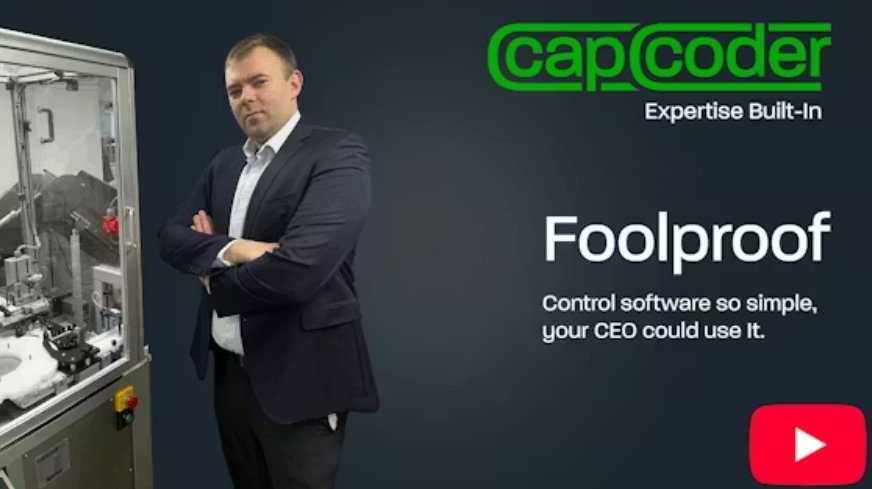
With foolproof control software and Expertise Built-In, Cap Coder machines simplify operation, reduce errors, and give you complete confidence on the production line.
Prefer to see it in action?
Watch how our intuitive control software performs on a real production line, and hear directly from customers who’ve reduced training time, cut errors, and taken back control of their processes.
Ready to Boost your Productivity?
Get in touch today and one of our friendly sales engineers will be in contact shortly.