 +44(0)1865 891466

Bottling Machine Safety: How We Measure Up

Nobody has ever described a guard as “mostly there” and meant it as a compliment. Bottling machine safety is binary: either the hazard is controlled or it isn’t. Legislation and harmonised standards govern filling, capping and labelling machinery, and they exist to control every hazard.
At Cap Coder, safety is built-in to every machine. It’s bottling machine safety that protects three things: the people who run the line, the product that leaves it, and the compliance record behind it.
How Cap Coder Machines Measure Up
Guarding Engineered Into the Frame
Cap Coder machines are built on aluminium extrusion frames with stainless steel covers and polycarbonate guarding. The guarding is part of the machine’s structure, not a separate enclosure bolted on at the end as an afterthought.
Because the polycarbonate is clear, operators can watch filling and capping in progress without opening a guard. Curiosity is one of the most common reasons people enter a hazard zone, and this removes it entirely.
Safety Components From Proven Manufacturers
Every Cap Coder machine, from the CC1440 bench-top capper to the largest fully automated monobloc, carries a full set of proven safety equipment as standard. Control is handled by Schneider PLCs, HMIs and servo drives, with SMC pneumatic systems.
Components from established manufacturers come with the certified reliability data needed to validate a safety function to EN ISO 13849-1. They also come with long-term spares availability, which matters when a machine is expected to outlast several generations of office coffee machines.
A Mechanical Layer Behind the Electronics
The Micro Mono’s servo-driven indexing starwheel is fitted with a mechanical clutch. The servo drives and control software already manage motion. The clutch adds independent mechanical protection that limits the force the starwheel can transmit if it meets an obstruction.
Two layers of protection working on different principles is stronger than either one alone. Belt and braces, engineered properly.
Removing the Hazard at Source
EN ISO 12100 puts inherently safe design at the top of the risk reduction hierarchy: if a hazard can be designed out, it should be. The Micro Mono E applies that principle directly. It is an all-electric version of the Micro Mono, using servos and electric linear actuators throughout, and needs no compressed air at all.
No air supply means no stored pneumatic energy, no air hose failures and no exhaust noise. It also removes compressed air as a contamination source, so the machine can operate in high ISO Class cleanrooms where air quality is tightly controlled. The safest hazard is the one that isn’t there.
Protecting the Product
Machinery safety standards protect people. For pharmaceutical, nutraceutical, cosmetics and life science manufacturers, the product needs the same level of protection. A closure applied at the wrong torque is a product safety failure every bit as serious as a guarding fault, and considerably harder to explain to a customer.
Cap Coder torque heads are servo driven, with both torque and speed fully controllable. Quick-release change parts reduce the set-up errors that creep in during frequent product changeovers. The optional torque transducer provides calibrated torque readings for quality-critical applications, giving objective evidence that seal integrity has been achieved rather than assumed. ROPP heads are available for roll-on pilfer-proof closures where tamper evidence is required.
Protecting the Compliance Record
Inspectors and auditors want evidence, not reassurance. A machine designed to the relevant standards is supplied with the documentation that proves it: the declaration of conformity, instructions for safe use and maintenance, and the information users need to meet their own PUWER obligations.
On the quality side, calibrated torque measurement gives quality leads verifiable data to support GMP records, rather than relying on periodic manual checks alone. When safety and quality documentation come from the same well-engineered machine, audits get shorter. Nobody has ever complained about that.
Engineered for Demanding Environments
As standard, Cap Coder machines are rated to IP44, and they can be specified to a higher rating where the application demands it. For manufacturers handling flammable products such as fragrances and alcohol-based formulations, machines are available ATEX rated as an optional extra.
The CC560 capper, for example, has been supplied ATEX rated to Zone 2, with anti-static plastics, metal grid guarding and a positive pressure electrical cabinet. EN 415-10 explicitly excludes the use of packaging machines in potentially explosive atmospheres, so these measures go beyond the packaging machinery standards and address the separate requirements that apply in hazardous areas.
Safety Across the Whole Line
A production line is only as safe as its weakest interface. Where individual machines are linked by conveyors and ancillary equipment, their safety systems must work together, so that a stop on one machine is handled correctly by every other machine on the line.
Cap Coder designs bespoke safety features to suit each application, from light curtains on a single machine through to full production line safety integration. Over-conveyor machines such as the CC570 are built to drop into an existing line, and their safety equipment can be integrated with the systems already in place. That avoids a surprisingly common problem: a new machine that is perfectly safe on its own, installed in a line whose overall safety has never been assessed as a whole.
We also design and build bespoke turnkey full production lines, integrating filling, capping, labelling, conveying and sealing into a single system engineered around your product and your facility. Each line is designed from the ground up rather than assembled from off-the-shelf modules. Every station is matched to your container, fill volumes and throughput targets, with smooth product transfer between stages and minimal manual intervention. The result is a reliable, high-uptime line that maximises output and delivers a strong return on investment.
Looking Ahead to 2027
The EU Machinery Regulation applies from January 2027, and the UK framework is aligning with it. If you are specifying equipment now, ask every supplier the same questions:
- Which harmonised standards does the machine comply with, and are they the current editions, such as EN 415-2:2025?
- What Performance Levels do the safety functions achieve?
- How are the control system and its software protected against corruption?
- What documentation is supplied, and in what format?
These are the questions Cap Coder machines are designed to answer. If a supplier goes quiet at question two, that tells you something! For a full breakdown of the regulations, read our guide to the UK legal framework and machinery safety standards
Safety Built-in
Safety cannot be sprinkled on at the end of the build. It is decided at the drawing board, in the choice of frame, guarding, components and control architecture, and in the decision to design a hazard out rather than guard against it.
For over 50 years, Cap Coder has designed and built filling, capping and labelling machinery in Oxfordshire for manufacturers who cannot compromise on protection for their people, their products or their compliance records. Safety Built-In is how that expertise is applied.
Related articles
Automated Medical Device Production: Nasaleze
Built for Modern Manufacturing
Today’s manufacturing environment is changing fast. Labour shortages. Skills gaps. Increasing product complexity. In this landscape, relying on highly specialised operators isn’t scalable.
You need systems that are:
- Easy to learn
- Easy to operate
- Easy to trust
That’s exactly what Cap Coder delivers.
Automation shouldn’t slow you down. It should move your business forward.
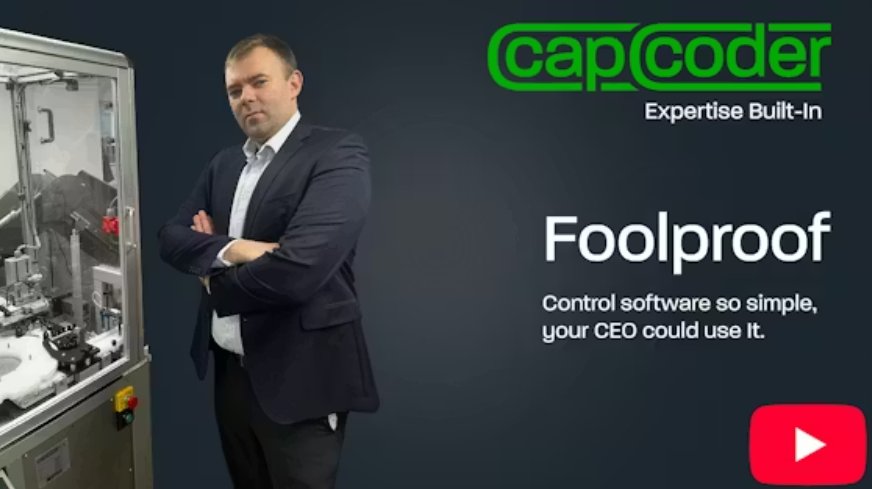
With foolproof control software and Expertise Built-In, Cap Coder machines simplify operation, reduce errors, and give you complete confidence on the production line.
Prefer to see it in action?
Watch how our intuitive control software performs on a real production line, and hear directly from customers who’ve reduced training time, cut errors, and taken back control of their processes.
Ready to Boost your Productivity?
Get in touch today and one of our friendly sales engineers will be in contact shortly.