 +44(0)1865 891466
How Much Does a Filling Machine Cost in the UK?

Ask ten suppliers how much a filling machine costs and you’ll get ten versions of “it depends”. Annoying, but true. In the UK, you could spend a few thousand pounds on a benchtop unit or north of £250,000 on a fully automatic, validated line, which is roughly the gap between a sensible hatchback and a small house.
In our article we aim to break down what actually drives the price, and shine a light on the costs that like to stay quiet until the order is placed.
Filling Machine Prices in the UK
Here’s how the UK Filling Machine market broadly breaks down:
| Machine type | Typical price range | Best suited to |
| Benchtop filling machine | Low thousands to £55,000 | Trial runs, low volumes, new products |
| Semi-automatic inline machine | £20,000 to £100,000 | Growing production with an operator loading or unloading |
| Fully automatic inline system | £60,000 to £250,000 | High-volume production without operator intervention |
| Turnkey monobloc or full line | Priced as a capital project | Integrated filling, capping, labelling, and inspection |
Please note that these figures are a guide. An unusual container, an aggressive product, or a demanding regulatory environment can move a quote outside these ranges. Prices estimated in 2026.
What Affects the Cost of a Filling Machine?
Throughput. Higher speeds need more filling heads and faster container handling.
Fill accuracy. Tighter tolerances call for servo-driven or mass flow dosing and better controls. For high-value products, this often pays back through reduced overfill.
Product characteristics. Viscous, foaming, flammable, or particulate products need specialist filling technology.
Materials of construction. Pharmaceutical and food applications typically require stainless steel contact parts and hygienic design.
Automation and controls. Recipe management, data logging, and audit trails that support EU GMP Annex 11 add cost but are often essential in regulated industries. (Related article: When should I move from semi-automatic to automatic filling?).
Changeover flexibility. Quick-change tooling for multiple formats reduces downtime but raises the initial price.
Integration. Connecting to existing upstream and downstream equipment takes additional engineering time.
Hidden Costs Beyond the Machine Price
The price on the front of a machine quote is a bit like the price of a printer: perfectly reasonable, right up until you need the ink. Equipment quotes are usually built around the base machine, and the things you need to actually install it, qualify it and run it have a habit of turning up as “optional extras”, or not turning up at all. Line two quotes up on headline price alone and one supplier can look like a bargain, with the real difference only revealing itself after the purchase order has been signed. So before you compare anything, we recommend you make sure every quote includes:
- Installation and commissioning, including site preparation and utility connections
- Tooling and change parts for each container and closure format
- Validation documentation such as IQ, OQ, and PQ
- External assessments, for example ATEX or UKEX certification and insurer inspections
- Operator and maintenance training
- Spares, calibration, and servicing
- Warranty terms, including whether labour and engineer travel are covered
- Facility changes to floor space, power, compressed air, or drainage
The Best Question to Ask
A more useful question than “what does a filling machine cost?” is “what will it cost to reach my required throughput, fill accuracy and compliance standard, installed and ready for production?”
Send every supplier the same detailed brief and ask each one to price the same scope of supply. This makes quotes directly comparable and brings exclusions to light before you commit. A low headline price that excludes change parts, tooling or validation support can end up costing more in total than a higher quote that includes them.
Related articles:
What Information Does a Filling Machine Supplier Need Before Quoting?
Bottling Machine Safety Built-In
How to Choose the Right Filler Machine: A Practical Guide for Manufacturers
Built for Modern Manufacturing
Today’s manufacturing environment is changing fast. Labour shortages. Skills gaps. Increasing product complexity. In this landscape, relying on highly specialised operators isn’t scalable.
You need systems that are:
- Easy to learn
- Easy to operate
- Easy to trust
That’s exactly what Cap Coder delivers.
Automation shouldn’t slow you down. It should move your business forward.
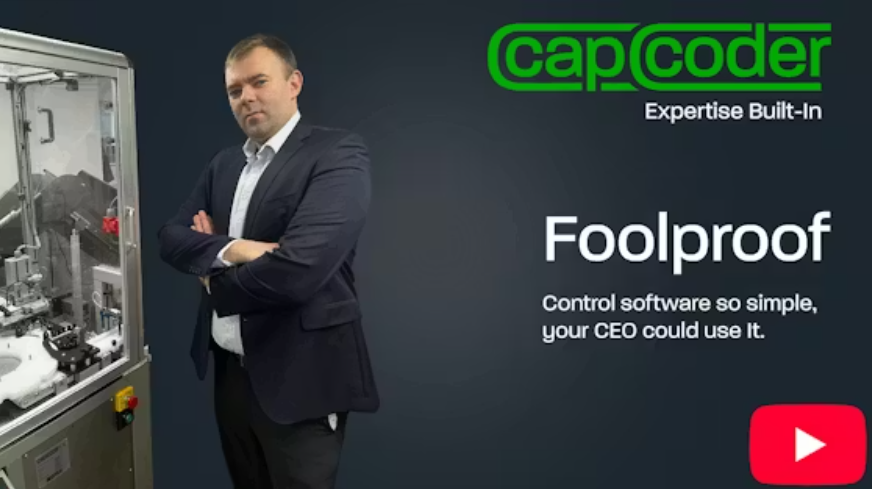
With foolproof control software and Expertise Built-In, Cap Coder machines simplify operation, reduce errors, and give you complete confidence on the production line.
Prefer to see it in action?
Watch how our intuitive control software performs on a real production line, and hear directly from customers who’ve reduced training time, cut errors, and taken back control of their processes.
Ready to Boost your Productivity?
Get in touch today and one of our friendly sales engineers will be in contact shortly.