 +44(0)1865 891466

Compliance Built-In,
Pharmaceutical Bottling Machinery
Cap Coder designs and manufactures pharmaceutical filling machines, bottle filling machines and capping machines for UK and international pharmaceutical, nutraceutical and life sciences manufacturers.
Every line is specified against your product, your container, your cleanroom classification and your GMP documentation requirements before a single component is selected.
Buyer’s requirements
What a Pharmaceutical Company Needs to Specify Before Buying a Filling or Capping Machine
Specifying a pharmaceutical filling machine, bottle filling machine or capping machine is not the same exercise as specifying general industrial packaging equipment. The machine has to be justified inside a quality management system, validated against a User Requirement Specification (URS), and supported by documentation an MHRA inspector can review. The requirements below are the ones a UK pharmaceutical buyer should have answers to, or should expect their machine supplier to ask about, before a quotation can be considered complete.
Product and container characteristics
- Product viscosity, foaming tendency, shear sensitivity and presence of particulates or suspended actives
- Fill volume range and required accuracy tolerance, typically expressed as a percentage or fixed volume deviation
- Container type and material: glass or HDPE/PET bottles, vials, or unit-dose containers, including neck finish and tolerance
- Cap type: screw cap, snap cap, tamper-evident closure, or child-resistant closure tested to ISO 8317
- Whether the product is light-sensitive, oxygen-sensitive, or requires nitrogen or inert gas dosing at fill
Cleanroom and GMP classification
- Required cleanroom grade for the filling zone, typically ISO 14644-1 Class 7 or 8 (broadly equivalent to EU GMP Grade C or D) for non-sterile oral and topical liquids
- Whether the product requires aseptic or terminally sterilised processing, which raises the cleanroom and machine specification to Grade A/B standards
- Product contact parts specified in 316L stainless steel or validated pharmaceutical-grade polymers
- CIP (clean-in-place) and SIP (sterilise-in-place) capability, or a defined manual strip-clean and revalidation procedure between batches
- Airflow, differential pressure and particle count requirements at the machine interface with the cleanroom
Validation and documentation
- A written User Requirement Specification (URS) agreed between quality, production engineering and the supplier before design work begins
- Design Qualification (DQ) confirming the proposed machine meets the URS
- Factory Acceptance Testing (FAT) at the supplier’s site, followed by Site Acceptance Testing (SAT) after installation
- Installation and Operational Qualification (IQ/OQ) protocols, and Performance Qualification (PQ) using the actual product and containers
- Calibration certificates for all metrology-relevant components, traceable to UKAS or an equivalent national standard
Regulatory and data integrity requirements
- Compliance with the UK Supply of Machinery (Safety) Regulations 2008 and UKCA marking of the finished machine
- Electronic records and audit trail functionality aligned with EU GMP Annex 11 expectations, where the machine holds recipe or batch data
- DSEAR/UKEX assessment and ATEX-rated components where the product or cleaning solvents present a flammable atmosphere risk
- Serialisation and aggregation capability to support Falsified Medicines Directive obligations, including 2D data matrix printing and verification at the line
- Change control documentation for any modification made to a validated machine after qualification
Throughput and line integration
- Required output in units per minute or per shift, and whether this needs to be sustained or is a peak figure
- Format changeover requirements if more than one container or cap size runs on the same line, and acceptable changeover time
- Upstream and downstream integration: bottle unscrambling, labelling, induction sealing, cartoning, serialisation and palletising
- Available floor space, ceiling height and services (compressed air quality, electrical supply, extraction) within the cleanroom envelope
- Whether the line needs to run semi-automatically now with a defined path to full automation as volumes grow
Commercial and lifecycle support
- Lead time from purchase order to FAT, and realistic installation and validation timelines
- Availability of spare parts, wear part schedules and UK-based service and calibration support
- Operator training provision and the technical documentation pack supplied with the machine, including the Declaration of Conformity
- Warranty terms and the supplier’s track record with pharmaceutical and regulated manufacturers specifically
- Whether the supplier can support future requalification if the product, container or cap changes
The Cap Coder range
Filling and Capping Machines and Processes Cap Coder Provides to Pharmaceutical Buyers
If you’re looking for a pharmaceutical filling machine or capper in the UK, look no further. Cap Coder has manufactured filling and capping machinery in the UK since 1976. The current range, from the Delta Fill through to the CC1160, is built and specified to serve pharmaceutical, nutraceutical and cosmetics manufacturers who need documented, GMP-compatible equipment rather than repurposed industrial packaging lines.
Pharmaceutical liquid filling machines
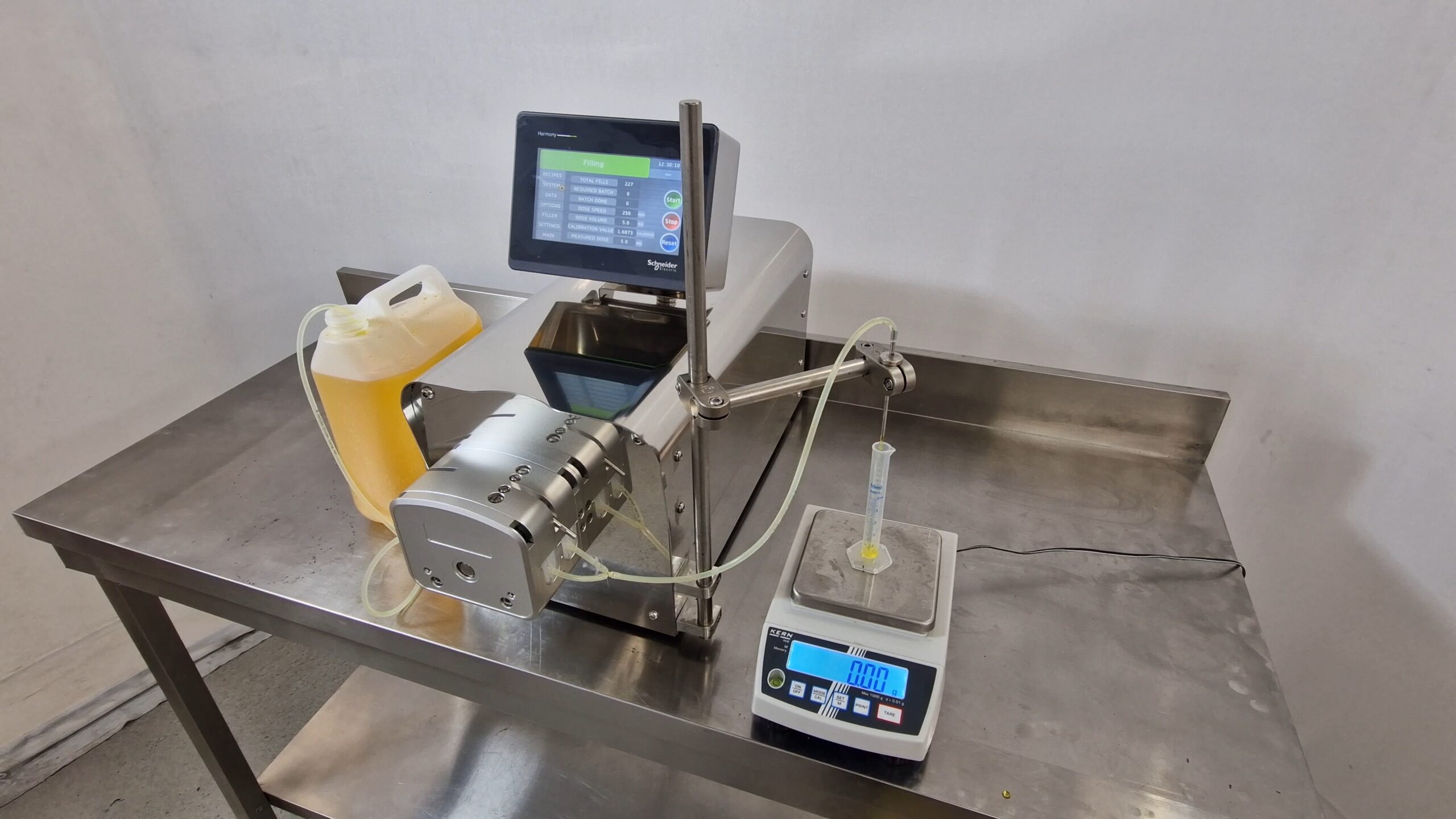
Volumetric and net-weight filling heads specified against the viscosity, foaming behaviour and fill accuracy tolerance of the product, with product contact parts available in 316L stainless steel for cleanability and chemical compatibility with liquid pharmaceutical and nutraceutical formulations.
Pharmaceutical bottle filling machines
Bottle filling machines configured for glass and HDPE/PET containers across the volume ranges typical of oral liquid, topical and nutraceutical products, with changeover parts engineered for defined format-to-format switchover times.
Pharmaceutical capping machines
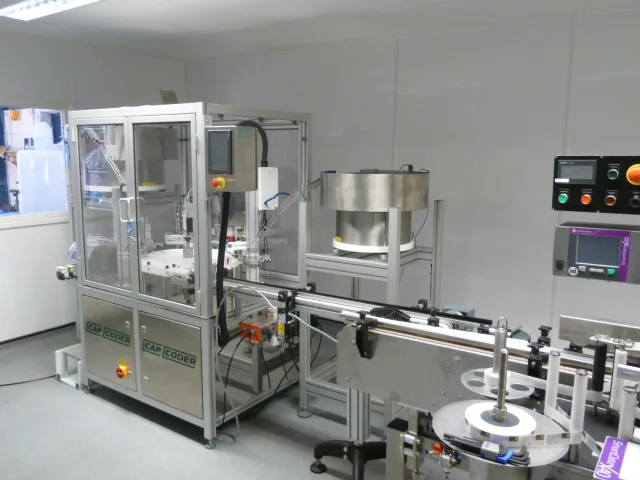
The CC570 semi-automatic inline capper delivers consistent, repeatable torque at up to 35 bottles per minute, reducing the cross-threading and seal failures that create rejected batches. Quick-release tooling brings product changeover down to around three minutes, and the machine can be supplied for Zone 1 or Zone 2 ATEX hazardous environments, with FAT/SAT, DSEAR and GMP/GAMP validation documentation available.
Torque transducers for GMP torque validation
An independently calibrated, UKAS-traceable torque transducer fits to the MK VI capping head to measure both applied and undoing torque, with resolution to within 0.1%. Live readings are shown on the HMI, and results can be captured and exported by CSV, XML or a US Digital-compliant file for batch records. The transducer can test one cap in every 10, 20 or 50 containers, applying, reading and un-doing each cap in sequence, and product outside the set torque tolerance is automatically rejected or flagged for the operator. It fits across the capping range, from the CC1440 benchtop machine through to fully automatic CC1160 monobloc lines, and can be combined with machine vision for further validation. Developed with pharmaceutical legislation in mind, it gives quality teams calibrated evidence that no unqualified product proceeds through the manufacturing cycle.
Cleanroom-ready builds
Machines built for integration into ISO 14644-1 classified cleanroom environments, with construction and surface finishes chosen to support the cleaning and environmental monitoring regime of the cleanroom grade the product requires.
GMP documentation and validation support
Support through the URS, FAT and SAT process, with documentation packs structured to feed directly into customer IQ/OQ/PQ protocols, so the machine arrives with the paper trail a quality department and an MHRA inspector expect to see.
Semi-automatic to fully automatic pathways
Lines specified so that a pharmaceutical manufacturer can start on a semi-automatic filling and capping setup and move to full automation as volumes grow, without discarding the qualification work already completed on core components.
Case studies
Pharmaceutical Manufacturers Cap Coder Has Supplied
Two examples of Cap Coder equipment running in regulated pharmaceutical and medical device production, from a global CDMO’s oral solid dose packaging line to a scaled-up medical device manufacturer.

Almac Group: Capping Integrity & Changeover Efficiency
Almac Group, a global contract development and manufacturing organisation, needed guaranteed seal integrity, repeatable validated torque, and efficient changeovers for a new oral solid dose packaging line. Cap Coder’s CC560 Capping and Re-Torquing system, built on their existing CC1440 capper installed in 2015, separates capping and torquing into dedicated units for tighter control over seal quality.
Two CC560 systems installed in 2022, alongside a CC1440 in place since 2015
“I chose Cap Coder for their quality, service, and because they’re genuinely customer-driven… Cap Coder don’t just supply equipment, they work with you as an engineering partner.” — Brandon Ruggiero, Engineering Co-Ordinator, Almac Group
Read the full case study →
Nasaleze: Automated Medical Device Production
Nasaleze, a UK family-run healthcare company, produces an FDA-approved, ISO 13485 and ISO 9001 compliant powder nasal spray classed as a medical device. Manual filling and capping capped output at 1,000 bottles a day with six staff. Cap Coder’s CC1160 Monobloc and CC1160 Twin Head systems, with UV sterilisation, confocal fill-level checks and torque-monitored capping, automatically reject any bottle that fails validation.
Production scaled from 1,000 to over 30,000 bottles per day
“Cap Coder’s engineers combine technical expertise with practical, hands-on support. Their family-run, collaborative approach aligns naturally with Nasaleze’s values, turning complex automation challenges into straightforward, successful solutions!”
Read the full case study →Packaging Machinery Built to UK and EU Safety Standards
Looking into the safety standards behind a filling machine, capping machine, or packaging line is exactly the kind of due diligence we want customers to do. Every Cap Coder machine is designed, risk assessed, guarded, and documented to meet the Machinery Directive (2006/42/EC) and the equivalent UK Supply of Machinery (Safety) Regulations 2008, with CE marking and a full Declaration of Conformity supplied as standard. We don’t treat machinery safety compliance as a box-ticking exercise carried out at the end of a build. It’s part of the design brief from the first sketch, so the filling and capping machinery that arrives on your line is demonstrably safe for your operators to use, every shift, every day.
CE Marked Filling and Capping Machines
Each machine carries CE marking, backed by a full Declaration of Conformity and a technical construction file we keep on record for the lifetime of the machine.
Risk Assessment on Every Build
Every machine goes through a formal risk assessment for packaging machinery, identifying and designing out hazards at the source, not just adding a warning label after the fact.
Machine Guarding, Interlocks & Light Curtains
Fixed and interlocked guarding, emergency stops, and, where the application calls for it, light curtains or safety scanners, specified for the actual hazards of your filling or capping process rather than a generic template.
Safety-Rated Emergency Stop Circuits
Emergency stop and interlock circuits are engineered to a defined performance level, so a guard door or e-stop on your packaging line reliably does what it’s there to do.
Declaration of Conformity & Full Documentation
Every machine ships with a Declaration of Conformity, complete user manual, electrical and mechanical drawings, and maintenance guidance, so your team has everything needed to operate it safely and keep it PUWER compliant once it’s on your line.
Built Around Your Operators
Intuitive HMIs, clear access for changeovers, and sensible ergonomics, because a machine your team trusts and understands is a safer machine to work alongside.
Read the directives and guidance for yourself
Common questions about packaging machinery safety
Are Cap Coder filling and capping machines CE marked?
Yes. Every filling machine, capping machine, and monobloc line we build carries CE marking and is supplied with a full Declaration of Conformity, confirming it meets the Machinery Directive 2006/42/EC.
What safety standards do your packaging machines meet?
Our machines are designed with reference to harmonised standards including EN ISO 12100 for risk assessment, EN ISO 13849 for safety-related control systems, and EN 60204-1 for electrical safety, alongside the essential health and safety requirements of the Machinery Directive.
Is your machinery compliant with the Machinery Directive?
Yes, every machine is compliant with the Machinery Directive 2006/42/EC and the UK Supply of Machinery (Safety) Regulations 2008, which currently apply in Great Britain alongside indefinite recognition of CE marking.
Will your machines help me stay PUWER compliant?
Keeping equipment PUWER compliant on your line is your responsibility as the employer, but we make it straightforward: every machine ships with the user manual, maintenance guidance, and documentation your team needs to operate and inspect it safely.
What safety features come as standard on your filling and capping machines?
Guarding, interlocks, and emergency stops are specified for every machine as a baseline. Depending on the process and the hazards identified in the risk assessment, we can also add light curtains, safety scanners, or full production-line safety integration.
Frequently asked
Pharmaceutical Filling and Capping Machine Questions
Specifying a Pharmaceutical Filling or Capping Line?
Share your product, container, cleanroom grade and validation requirements and Cap Coder’s engineering team will work through the specification with you before quoting.Ta