 +44(0)1865 891466
8 Essential Checks to Prepare Your Filling & Capping Line for 2027

Updated for 2027
The end of the year is when most production teams set next year’s volumes, budgets and maintenance windows. It is also the best time to find out whether your filling and capping line can deliver them.
A line that ran acceptably through 2026 can still hide worn seals, drifting fill weights or torque that has crept out of specification. Under higher volumes in 2027, those small issues turn into rejects, unplanned stops and failed audits.
The eight checks below give plant managers, quality leads and production engineers a structured way to assess line readiness before the new year starts. Each one can be completed by your own maintenance team, and together they show where to spend time and budget first.
The 8 Essential Checks
1. Inspect Product-Contact Parts for Wear and Fatigue
Pumps, piston seals, valves, nozzles and tubing all wear with use, and wear shows up first as small changes in fill volume or dripping at the nozzle. Strip down and inspect every product-contact part against its expected service life. Replace seals and O-rings that show swelling, cracking or flattening, and confirm the materials are still compatible with any new products planned for 2027.
2. Verify Fill Accuracy and Repeatability
Run controlled test fills on each head and record the results by weight. Look at both accuracy (how close the average is to target) and repeatability (how tightly results group). Drift in either points to wear, air in the product path or calibration that needs resetting. Keep the results, as they become your baseline for the year and support cGMP documentation.
3. Check Torque Heads and Closure Application
Under-torqued caps leak and fail seal integrity tests. Over-torqued caps crack, strip threads and make the product hard to open. Measure application torque on a sample of closures from every head and compare it with the closure manufacturer’s specification.
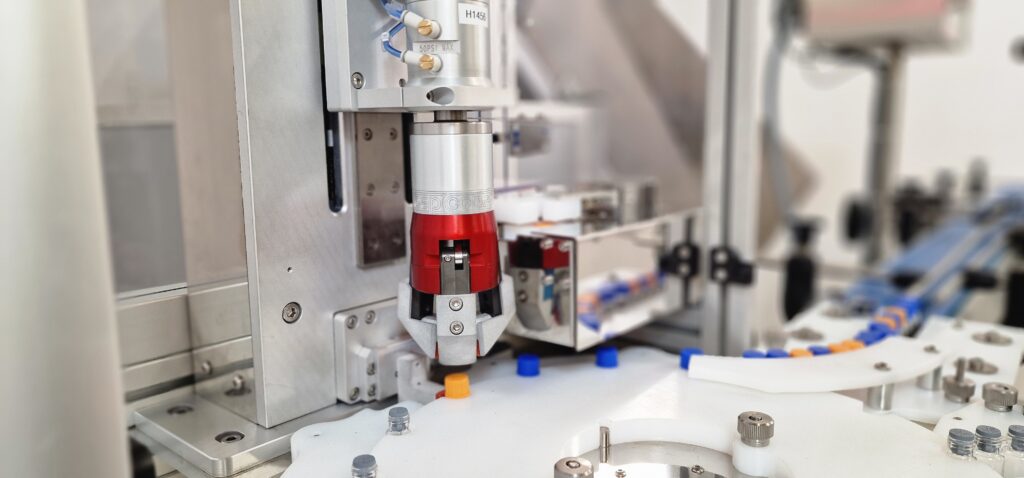
Check the clamping jaws or chuck inserts for wear, as worn grip surfaces cause slippage and inconsistent torque. If your 2027 plans include new closure types, confirm the head can handle them. Some modern torque heads, such as the Torque Head, apply both crimp and screw closures without a head change, which reduces changeover time on mixed product runs.
4. Assess Timing, Alignment, and Synchronisation
Filling and capping stations need to work at the same rate, with containers arriving in the right position every cycle. Check conveyor speed, guide rail settings, star wheels and indexing against each container format. Misalignment causes spills, crooked caps and jams, and it gets worse as line speed increases.
5. Listen for Vibration, Noise, and Irregular Movement
New noises, vibration or jerky motion are often the earliest warning of bearing wear, loose fixings or a failing drive. Run the line empty and under load, and note anything that has changed since the last inspection. Fixing it during a planned shutdown costs far less than an unplanned stop in a busy quarter.
6. Review Changeover Components and Setup Accuracy
Check that every change part is present, labelled and in good condition, and that set-up settings are recorded for each product. Time a typical changeover and compare it with your target. If 2027 brings more SKUs or shorter runs, changeover time will have a direct effect on available capacity.
7. Validate Controls, Sensors, Interlocks and Safety Systems
Test every sensor, interlock, guard switch and emergency stop, and confirm HMI settings and recipes are backed up. Check that reject systems, such as no-cap or low-fill detection, actually reject. If your customers or auditors expect batch records or track and trace data, confirm the line captures and stores what is needed.
8. Review Maintenance History against 2027 Production Plans
Compare last year’s breakdowns, spares usage and downtime with the volumes planned for 2027. A simple question helps here: at your target output, how many hours a week will the line need to run, and how much margin is left for maintenance and changeovers? If the margin is thin, now is the time to plan upgrades, extra shifts or additional capacity rather than mid-year.
Frequently Asked Questions
How often should a filling and capping line be fully inspected? At least once a year as a full review, with fill accuracy and torque checked far more often, usually at every batch or shift start. A year-end review fits well with planned shutdowns and budget setting. To book an annual service, click here.
What is the most common cause of inconsistent cap torque? Worn clamping jaws or chuck inserts that let the closure slip, followed by incorrect torque settings for the closure type. Measuring torque regularly on sample closures catches both.
When should a line be upgraded rather than repaired? When repeated faults, rising spares costs or capacity limits stop the line meeting planned volumes, or when new products need closure types or fill ranges the current equipment cannot handle.
Start 2027 With a Line You Can Rely On
Working through these eight checks now gives you a clear picture of your line’s condition and capacity before volumes rise. It also gives you the evidence you need to justify maintenance, spares or upgrade budgets for the year. Contact our service department.
Less downtime. More results. And a filling and capping line ready for the year ahead.
Ready to Boost your Productivity?
Get in touch today and one of our friendly sales engineers will be in contact shortly.